
Breast augmentation : Risk of capsular contracture – What you should know
What exactly is capsular fibrosis?
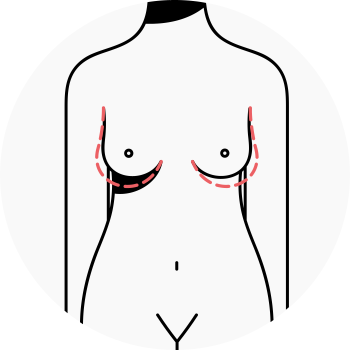
Dr. Brölsch: As soon as a breast implant, pacemaker, or prosthesis is inserted into the body, the immune system surrounds the foreign object with a capsule of tissue. This process is a normal immune response of the organism, always occurs, and is usually not problematic because the capsule remains soft and elastic. In breast augmentation this formation is also very useful because it ensures that the implant does not shift. In rare cases, the body forms a thicker and firmer layer around the implants. This so-called capsular contracture can then lead to hardening and pain in the breast; in some cases, the capsule becomes so hard that it deforms the implant.
How common is capsular fibrosis?
Dr. Brölsch: According to the German Society of Plastic, Reconstructive and Aesthetic Surgeons (DGPRÄC), approximately five percent of female patients are affected by capsular contracture. According to the latest studies, the frequency may even be as low as one to three percent. However, these studies still need further evaluation.
What are the causes of capsular fibrosis?
Dr. Brölsch: The causes are still not fully understood. However, chronic infections are believed to increase the risk, which is why we always perform a minimal-touch technique intraoperatively in our specialist practice in Braunschweig, as well as administering antibiotic prophylaxis to the gluteal area . The implant material, the patient's age, bleeding in the breast, and an unfavorable implant position can also play a role. Our practice team is highly experienced in breast implant placement, so we keep the risks as low as possible, and our patients are generally completely satisfied augmentation
Can I prevent capsular contracture?
Dr. Brölsch: No, since capsule formation is a normal and desired immune response, there are no preventative measures. However, to detect potential capsular contracture early, we recommend an annual check-up of the implants after breast augmentation . This check-up can also be performed by a gynecologist. Of course, it is always best to consult your treating physician, who is familiar with your complete medical history.
Are there implants that reduce the risk?
Dr. Brölsch: Older generation implants, in particular, are said to cause capsular contracture. In our Braunschweig practice, we only use the latest generation with so-called microtexturing or nanotexturing. These implants have a fine surface and reduce the risk of capsular contracture.
If I develop capsular contracture, will my implants have to be removed?
Dr. Brölsch: Generally, implants only need to be removed if the patient is experiencing pain (Grade III) or if the implants become unsightly due to a hardened capsule (Grade IV). We also perform this procedure on patients whose implants were inserted in another practice.


